


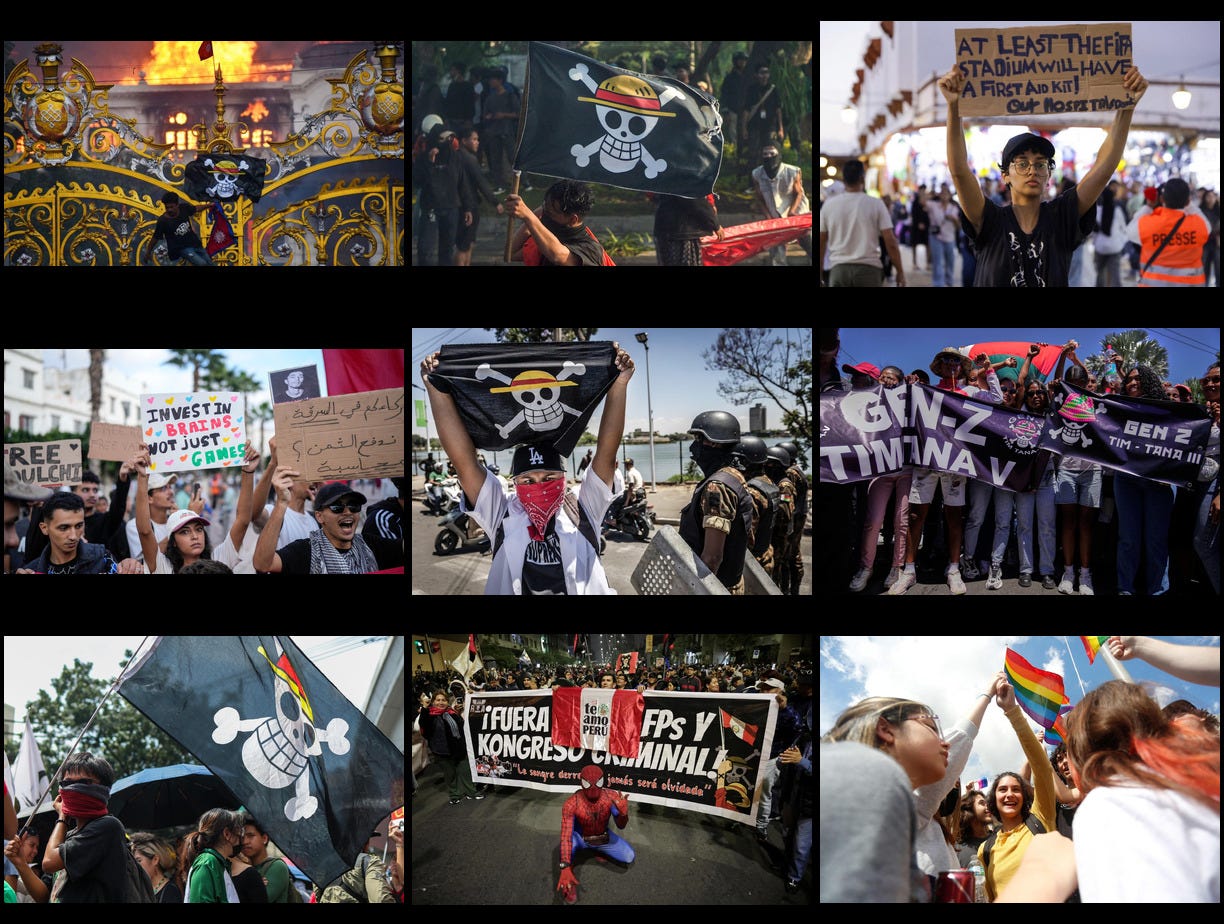
The young are restless! Now clubbed into a group called Gen Z, they are taking to the streets, fighting governments - from Nepal, Bangladesh, Sri Lanka, Madagascar, Morocco, Peru and Kenya, with significant movements also in Indonesia, the Philippines, Serbia, Togo and Mexico. The first breakout of Gen Z was the LGBTQ+ movement in the US.
The issues are different from corruption, unemployment, lack of affordability, identity politics, LGBTQ+ questions, climate anxiety, breakdown of government services, education, and a general sense that the world is broken.
We, of the greying generations before them, judge them, their work culture, their lax timelines, mental-health days, entitlement, etc. We also marvel at their me-first, me-always lens, probably a little of that would be good for us. We are offended that Gen Z is out of break what we are desperately trying to hold together - our entire world.
I considered the dharmic appreciation of Gen Z in an earlier post (also linked below). Here I want to suggest that the Gen Z protests are a symptom - an effect. They are not the problem. Their anger is real but their direction is manipulated using an ingenious technique during their coming of age.
How to manipulate a generation?
The process is simple - find their grievance, isolate them, group them under an identity and direct them at some target.
The science of manipulation is well understood. It has been studied for a very long time. From Dale Carnegie to study of Germany in World War II, Korean war, to Milgram, Tajfel and Turner, etc.
The tools are different, adapted for today’s world.
First, we need grievance!
At the centre of manipulation is a grievance. Expert manipulators know that they cannot choose a grievance well in advance. An imposed grievance does not connect and thus does not have the power to seed a movement. The best course of action is to highlight all the grievances, amplify them and poke them to check if you hit a nerve. This process goes on all the time. Leaders connected with grassroots are able to put their finger on the pulse of the masses very effectively. Those disconnected, cannot amplify a genuine grievance even if it is served to them on a platter.
Isolation is critical
The basic template of isolation is simple - convince the person that no one understands them. Not parents, not teachers, no one from college, not seniors, not bosses - no one! Technology makes it easier. It captures her attention, makes the real-world a boring distraction, and keeps connections shallow. So many connections but none meaningful make the isolation real.
Isolation alone is not enough. For a movement to rise you need action. A blissful isolation leads to peace. A sad isolation leads to inaction - pathos. You need to create an uncomfortable isolation, an angry isolation.
For anger, you need dissonance. A stark contrast between their hopeless situation and possible bliss that others are enjoying creates a dissonance that feeds the anger. Starker the contrast, more the anger. So, make it starker - make the pain real and the pleasure fake. Hammer upon their grievances. Convince them that ALL paths lead to pain and suffering. Redirect the natural instinct of pursuit of happiness to fake highs and call it experimentation. For older generations it was cigarettes, then weed, then harder drugs, even pain-killers, each generation had some fake-happiness path sold to them.
Thus isolated, disillusioned and angry youth ask the expected question. Why can’t their world-view become true? Their innocent world view that says accept all, embrace all, universal love, world peace, pro-animal, pro-environment, pro-inclusivity, no hunger, prosperity for all, etc. Why can’t we have it?
The ideals are not inherently wrong. But when they become the only lens, they produce two responses.
Some turn inward and change themselves: Rastafarian movements, hippie culture, veganism, or radical shifts in sexual identity and preferences.
Others turn outward and try to change the world: the classic rebel youth, “save the planet,” clean the rivers, volunteer for the poor, save the stray dogs, etc.
For political disruption we need them in groups
An isolated person aches to belong. So YOU hand them a group. YOU define it for them, through media, through the socials, through a thousand small messages, until they accept your label as their own. You give them a special language. Gen-Z lingo is not an accident; a private dialect that outsiders cannot follow - it is an innovative fence. It keeps the herd inside and everyone else out. This way, YOU get to define them. They rely on the algorithm and the influencer decide it for them. And you decide WHO is that influencer!
To make the group closer, you make others resent this tribe. “Gen-Z has no work ethic.” “They are too sensitive, they are triggered by everything.” The resentment is not a side effect. It is manufactured by amplifying the slacker from the Gen-Z group. Mutual contempt brings the group close ranks. And once the group is sealed, you control the leader — or, in a leaderless movement, you control the mood, which is even better, because a mood cannot be arrested.
Now you have a weapon in search of a target!
Your weapon is an isolated, wounded, morally certain, tightly-bonded group that speaks its own language and distrusts everyone outside it. All that remains is to aim it and fire to get a massive confrontation.
But you have to be careful before confrontation erupts. In a confrontation, the group dynamics get exposed, the shortcomings come to the front - most groups fizzle out. Hence it is important to choose the right target at the right time for the group. Aim it at the government and you get regime change. Aim it at society and you get a culture war.
Do it right and you see organised movements like Occupy Wall Street, pride parades, and now the Gen Z uprisings we are witnessing from Kathmandu to Lima.
This is not unique
One may say it is essential to the society. The youth aspiring for an ideal world with energy, vigour, a low tolerance for hypocrisy, a sense that injustice can actually be fixed are all part of growing up. So is the hunger to bond with one’s own kind. These are not unique to Gen-Z. They were true of us, and of our parents, and of theirs. The young will always find their tribe. In every single generation, they do.
So the interesting question is not how to stop them. You cannot, and you should not want to. The interesting question is this: how do we make sure that this tribe betters humanity — challenges our institutions, questions our lazy assumptions, forces us to be better —without tearing the social fabric apart in the process?
A better way? Yes, it is possible
The mistake is to ask what is wrong with Gen-Z. The right question is what Gen-X, the millennials and the rest of us must do differently. Because the manipulation only works on a generation that feels unheard. Close that gap and the machine loses its fuel.
First, listen
Not the performative listening where we wait for our turn to lecture. Actual listening. Their grievances are real be it corruption, a rigged economy, no jobs, no housing, a planet on fire.
Then, connect
If isolation is the foundation of the whole scheme. Connection is the antidote. A young person who has one older person who genuinely gets them is far harder to radicalise, in any direction.
Acknowledge our own shortcomings
We have to be honest about the world we are working in. This generation comes of age at a moment when truth itself is ideologically-coded and fake news makes it impossible to know true facts. We let this happen. The least we can do is be truthful in how we report the world to them.
And we should ask ourselves hard questions. Are we actually focused on making things better — or just on being right? We too were dealt a bad hand by history. But let us not take it out on the young.
Highlight the good
The algorithm hates good news. It will happily feed me sunny days and cats having fun — rainbows and puppy dogs — and it will happily feed me outrage. What it will not feed me is progress. So we have to supply it ourselves.
Give me the news of improvement, of things that are quietly getting better. Give me realism — the world is not perfect, it never will be — but the truth is that it is improving. And, most important of all, cheer them when Gen-Z improve somethings. Let them know they are part of the improvement, not merely victims of a decline.
Dividing the world into two tribes — old versus young, left versus right, us versus them — forces everyone to pick a side. But there are never only two sides. There are many sides, many tribes, and the real ones do not run along generational lines at all. They run across generations. The decent people of every age group have far more in common with each other than with the loudest voices of their own cohort. That is the alliance worth building.
From outrage-maxing to sense-maxing
Modern media — social and traditional alike — is in the business of outrage-maxing.
Outrage is profitable; sense is not.
We do not have to play that game. We can talk sense. We can tone it down. We can, deliberately and stubbornly, notice and reward good behaviour instead of amplifying the worst. In an economy built on outrage, calm is a defiant act.
In sum
Gen-Z is not the problem. Gen-Z is the alarm. The discontent is real, the template used to channel it is ancient, and the responsibility for what happens next sits — where it has always sat — with the older generations who are working this world and hold its levers.
So the onus is on us. Patience is the key; a generation cannot be argued out of its anger overnight, and it should not be. And in the end we must do the oldest thing of all — simply follow our dharma. Do our duty by the young, honestly and without agenda, and trust that a generation that is truly heard has no need to be manipulated by anyone.
