


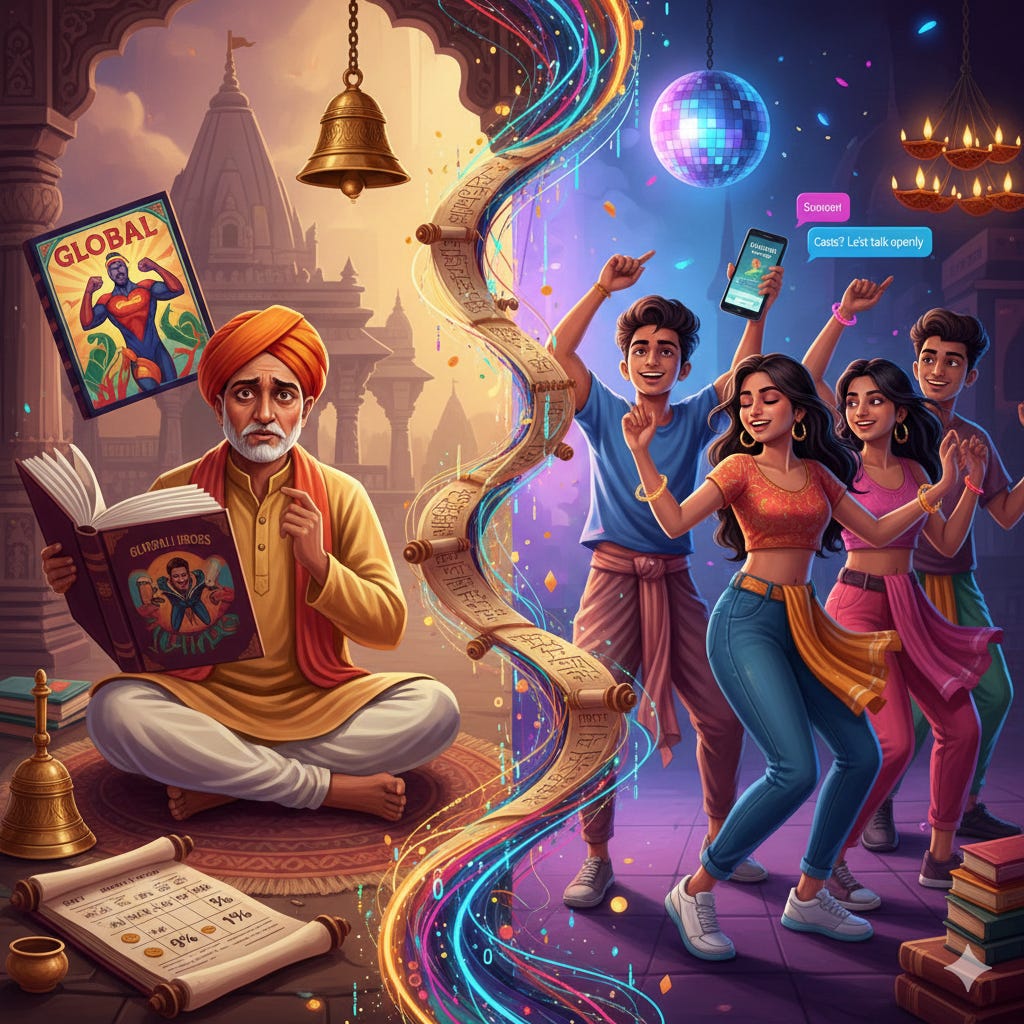
In a X thread, Sameer critiques an article in The Print by Karanjeet Kaur, arguing that it misinterprets Gen Z’s cultural trends as a shift toward conservatism or religious orthodoxy.
Instead, Sameer says, Gen Z is proudly reclaiming and modernising Indian culture—such as through “Bhajan Raves,” ethnic clothing, and spiritual tourism (e.g., preferring the religious Mathura over drug-alcohol-Goa)—as a rebellion against older generations’ internalised view that modernity equals Westernisation.
Sameer highlights how “Boomers and millennials continually moral policed speech, belief, and identity for decades”. He further states that
“Millennials and boomers are not “neutral observers” here. They are the repressed generation that has been convinced that anything Indian and culturally oriented is “conservative” and “regressive”. GenZ is proud and aggressive because boomers were apologetic and docile.”
This highlights two important points for me. First Gen Z is ready to take its place as heirs to our cultural traditions. And second, that Boomers and Millennials should make some room for their cultural expression.
Coming from what is called Gen X, between Boomers and Millennials, I want to explain our position and expand the discussion.
Sameer is right.
Boomers to Millennials (me being GenX) have imported the structure of culture from our Western education.
Many in our generation believe culture is rigid and structured around rituals and discipline. These generational brethren of mine shudder at some of the cultural changes that Gen Z is experimenting with.
To an extent, it is not their fault. We knew our “culture” from what we found in Western narratives, our textbooks, and socialist-communist-influenced media and intelligentsia. We knew this wasn’t right. But we were ridiculed. We did not have proper arguments, research, and power. Many of us were fighting economic survival.
We, as did generations before us, felt it was our responsibility to “save” what we “know” of our culture and bide our time till we can explore for ourselves the facts and interpretations of our culture. That saving required a conservative outlook, a rigid structure bolstered by rituals and discipline.
But we knew this “knowledge” of our culture is also not totally uncorrupted. It is why, to an extent, we have isolated our GenZ kids from our imposed understanding of culture. But yes, we may have confused our Gen Z kids to a certain extent.
So we did what we could.
We tried to fit what WE know from our culture into the “singular foundational definition” of culture as taught in the West.
We discovered it did not fit, and we have lived with this dissonance and sought its roots. We did not find discomfort in our dissonance, and that struck us as a core strength of our culture.
We just realised that what we “know” of our culture is the flawed Western observation of it. We are realising that the lens through which our culture was being observed was flawed and that the observer herself was unaware.
Yes, we, and generations before us, have held on to the past. We held on to it for a time when we can observe, understand, examine, rectify, nurture this culture of ours and allow it to grow and evolve. That time has come. That is why Rajiv Malhotra calls for a scrutiny of our culture using our lens.
Culture is not static. It needs to change, evolve and grow.
I have felt what Sameer accuses my generation of. I realise we have to remain neutral in our observations of Gen Z’s actions. But I also think Gen Z needs to convince us that they will join us in researching, examining, debating, rectifying and understanding the journey of our culture thus far as we go about nurturing, evolving and growing this amazing culture into the future. These days, I am confident they will. It is a good feeling.