


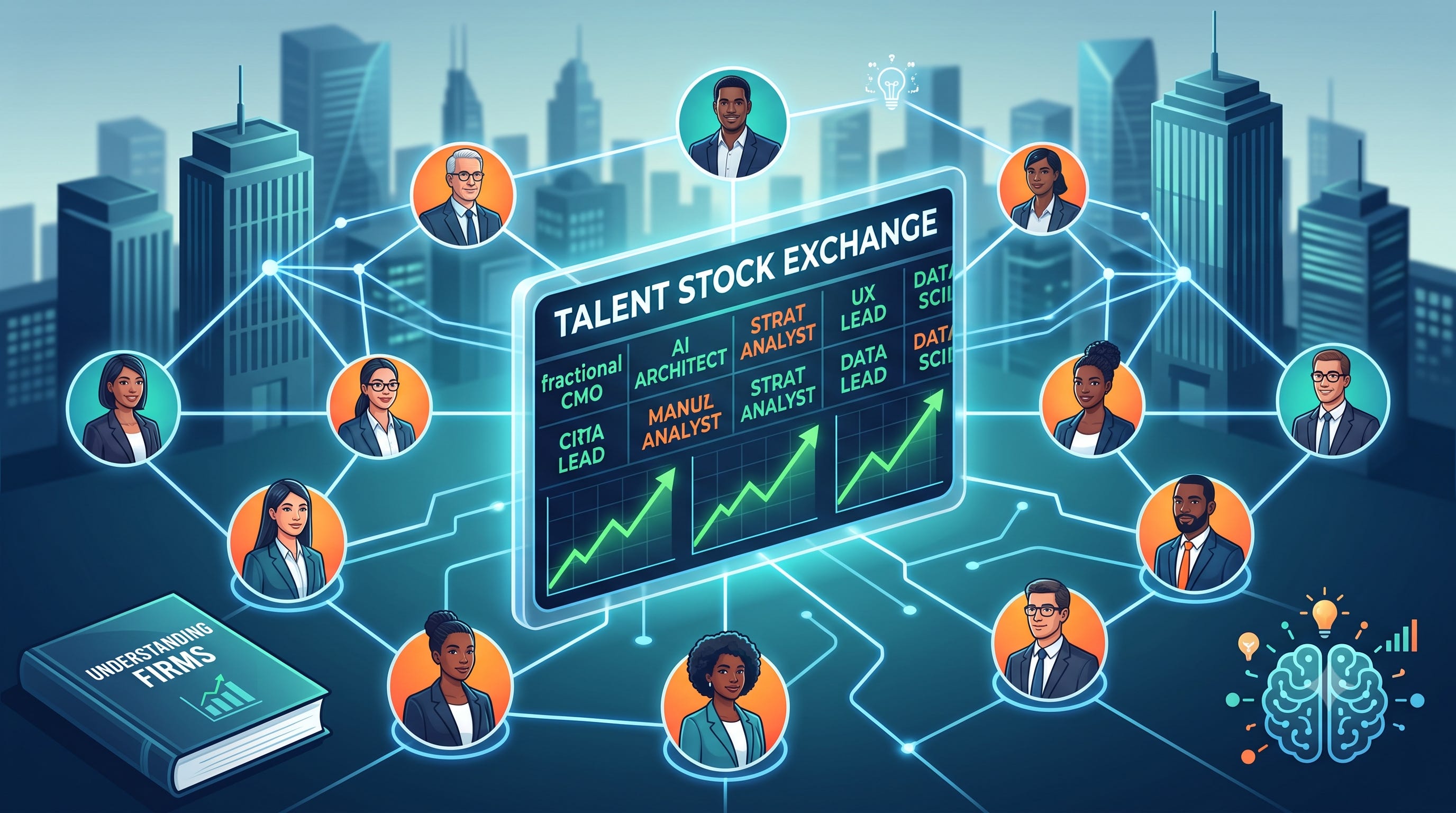
Back in 2014, when Thomas Piketty’s Capital in the Twenty-First Century was dominating discussions on income polarization, I wrote a piece examining the structural forces acting on the modern firm. At the time, the mainstream debate was fixated on the fear of robots taking our jobs. But the real economic friction was always about two conflicting forces: a firm’s constant drive to compress employee costs, and its simultaneous, desperate need for highly skilled talent.
When you extrapolate the confluence of those two forces, you end up with either a dystopian collapse of wages or a utopian era of free agents. Twelve years ago, that era had not yet arrived. Today, driven by the normalization of remote work and the massive productivity leverage of AI, we are finally watching it unfold.
The Unbundling of the Firm
To understand why this is happening, we have to look at the firm structurally. Over the past 250 years, we have transitioned from simple, independent value chains to highly interconnected, complex networks. (In my book Understanding Firms, I refer to these as Resource Transformation Chains).
Because these chains are so complex, specialized expertise developed in one area now has immense, diverse applicability across multiple chains. However, from the perspective of a single firm, the value of that talent is artificially capped. Employees with these capabilities consistently feel underpaid and switch jobs to force market corrections. Yet, even with substantial pay bumps, their compensation remains miniscule compared to the actual economic value they could potentially create.
The logical market solution, which I argued in 2014, was to organize these individual clusters of competencies into tradable units—micro-suppliers or free agents plugging into various value chains. Today, we simply call this the fractional workforce.
The Talent Stock Exchange
For this free-agent agglomeration to function, it requires a highly efficient market. Buyers (the firms) and sellers (the micro-agglomerations) need a place to discover, evaluate, and contract with one another.
In 2014, I saw LinkedIn as a potential talent stock exchange—a market where every professional operates like a listed entity. I assumed the platform itself would have to deploy algorithmic bots to validate the skills of these “listed entities” to make the market viable.
I was right about the market, but I was hoping from the wrong crowd. LinkedIn wanted to be the Facebook of professional-life. They did not attempt anything worthwhile in this space.
The performance visibility problem wasn’t solved by platform algorithms; it was solved by public signalling. Today, free agents advertise their own “value-set” through proof of work. Your Substack, your public portfolio, and your content output serve as evidence of your competencies and reputation. The validation problem still remains and so does the gap from this value-set to a “ticker”.
AI-Robotics as the Capital Multipliers
The automation anxiety of 2014 has morphed into the AI-robotics reality of today. But rather than simply displacing labor, AI is acting as a massive capital multiplier for top knowledge-work while robotics will amplify the productivity of effort-work.
Generative AI allows a single fractional worker to output the productivity of an entire traditional department. It is driving a localized productivity boom for those who know how to wield it.
Robotics, augmented with AI, will be able to attack productivity and effort-based tasks at an unprecedented scale. Returns to skill will be amplified dramatically.
In such an environment, every individual will soon realise that their specific skills are a market unto themselves. However, there is a distinct gap in validating the skill-sets and making talent tradable as easy as trading stocks on the stock market.
The era of the free agent is here, and it will lead us not just to a more efficient allocation of human capital, but to a fundamentally enriched and autonomous way to work. We need the enabler!