I try to be objective and change my mind when data and theory give me a better alternative. Yet, since 2007-08 some of the ideas I have held have not changed.
INR is undervalued. It has since been undervalued even more.
USD is overvalued and is losing credibility as global reserve currency. Its credibility was eroding glacially then and briskly now. It continues to be overvalued.
Our definitions of who are the rich people of the world are not correct. Weirdly, our definitions of who are poor are reasonably congruent. The economic mobility - how easy it is to become rich - has declined all over the developed world.
I also did not understand the obsession with residential properties with rental yields being so low.
Back in 2007, as I was waiting for my flight to Koh Samui, I wrote some of these questions down on my blog in a post titled 2008: Images from the crystal ball! I have spent almost 20 years trying to unravel the economic operating system. I have tried to validate the data and theories that lead us to these, what I call, discrepancies. There is a lot I have uncovered and highlighted here on RightVIEWS, in my books - Subverting Capitalism and Democracy AND Understanding Firms.
But the crux of it is this!
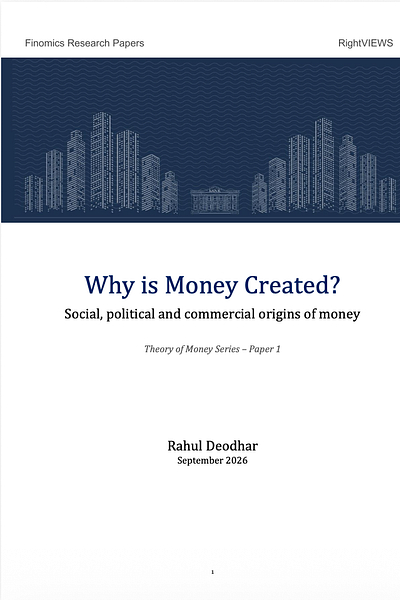
We need a foundational rethink of economics. And that the place to start is Money. The research is on-going but today I have for you the first paper in series of research papers on Theory of Money.
The first paper asks a deceptively simple question: why is money created at all? The conventional answer, descending from Adam Smith and formalised by later economists, is that money is a technical device invented to overcome the awkwardness of barter.
Drawing on Mary Mellor’s book Money: Myths, Truths and Alternatives (Policy Press, 2019), I argue that this answer is largely a myth. Mellor shows that money predates markets by thousands of years and that it has not one origin but three interwoven histories: social, political and commercial. Money is created because human societies need a trusted, countable way to record and settle obligations — first social obligations, then the obligations rulers impose and honour, and only later the commercial obligations of trade and banking. The commercial layer, though it is now the largest part of the money system and the engine of economic value, rests entirely on the social and political foundations that give money its validity.
Mellor’s book explains only the first part. But it exposes a lot of questions and helps us understand many statements we hear in our commentary on money, like for instance, US Dollar is backed by 12 aircraft carriers (or versions thereof) OR Argentinians have lost confidence the peso, etc. It also answers the shortcomings of the Euro, Bitcoin and community currencies.
If you want to delve into this topic, do download this paper and do share your feedback.