


Leadership programs often teach decision-making, adaptability, execution, communication, and teamwork.
Classical arts train all of these too.
The difference is that they are not learned as concepts. They are lived, practiced, repeated, corrected, embodied, and internalized. What emerges is not simply knowledge about leadership, but a certain way of being.
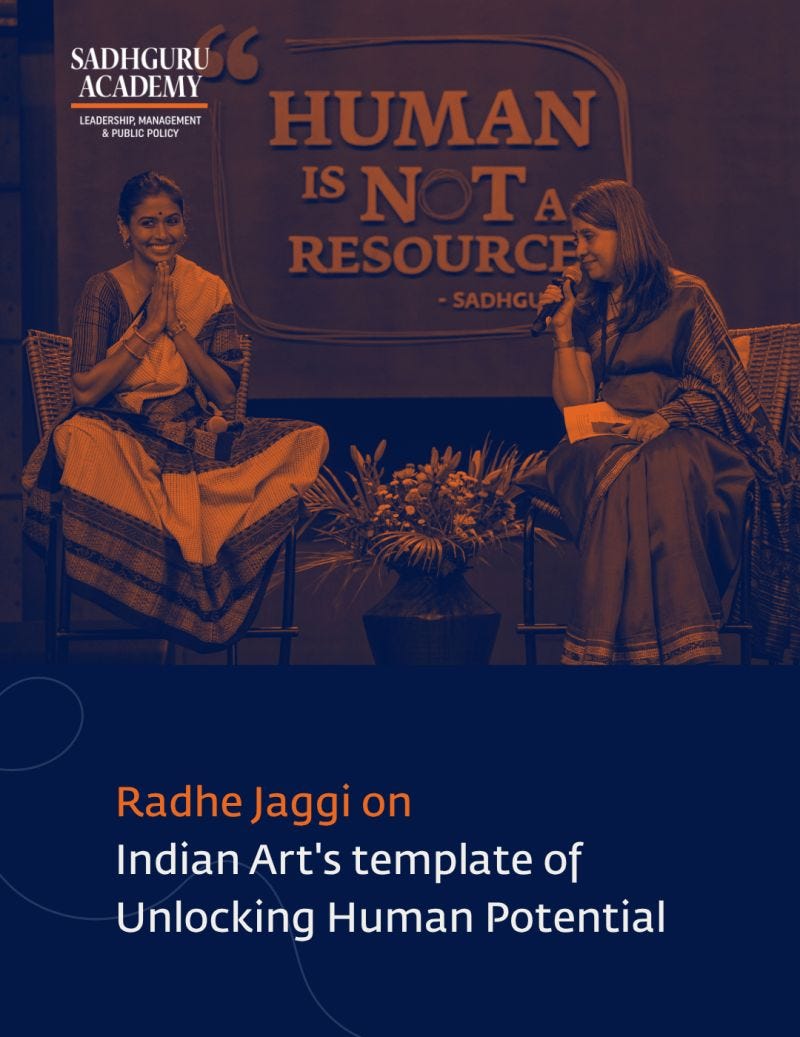
I attended a recent conversation at Sadhguru Academy’s ‘Human is Not a Resource’ program, Radhe Jaggi shared how her decades of training in classical dance shaped capabilities that are directly relevant to leadership. What was interesting to me, was that none of these lessons came from a classroom. They emerged from rigorous artistic practice.
1. The Ability to Drop What Isn’t Working
One of the most valuable leadership qualities is the ability to let go of an idea, a concept or a process that is failing and quickly move toward a better possibility.
Radhe described how artistic training develops this naturally.
“The minute you realize that something is not working, it’s very easy to implement whatever corrections you want to implement because that’s what you have been doing your whole life.”
Artists live in an environment where constant refinement is normal.
“There’s always somebody who’s a better dancer than you, there’s always somebody who’s more creative, somebody who’s got better stage presence.”
Because improvement is built into the culture, criticism becomes information rather than a personal attack.
She recalled a performance review from her father that came just days before a major tour:
“He just looked at me and he said, ‘Can I be honest with you? This simply won’t fly.’”
Her response was not defensiveness.
“I know it was very bad, but tell me what’s not working.”
Many leaders struggle because they become attached to plans, opinions, or strategies. Artistic training repeatedly teaches you to separate yourself from the work and focus on improving the outcome.
2. Rasa and the Duty to the Audience
Perhaps the most powerful leadership lesson came through her explanation of Rasa.
Rasa is often translated as emotion, but Radhe described it as something much deeper.
The performer’s responsibility is not merely to feel something.
The responsibility is to take the audience through the same journey.
“You are trying to create an emotion and the audience is trying to experience that same emotion.”
She explained that if the audience is merely admiring the performer, Rasa has not happened.
“You also have to be with me step on step and your emotions have to rise and fall along with me.”
This is equally true in leadership.
Every meaningful enterprise begins with a certain bhava. A founder sees a possibility. A teacher wants to awaken learning. A healthcare provider wants to reduce suffering. A business wants to solve a problem.
The role of leadership is to ensure that this original intent is experienced by everyone involved.
Employees understand it.
Partners align with it.
Customers feel it.
Stakeholders experience it.
Radhe shared a story. During a rehearsal, a performer became so emotionally overwhelmed while portraying Sita that she began crying on stage. Many thought it was beautiful. But another artists said,
“You are failing your audience by being overwhelmed with your own story in your head.”
That sentence could sit comfortably inside any leadership handbook.
A leader cannot become absorbed in personal emotions, personal victories, or personal struggles.
The duty remains.
“Your business is to take these hundred people, three hundred people, ten thousand people along with you on that journey.”
There is another gift hidden here.
Dance repeatedly allows a person to inhabit different emotions, different characters, different perspectives.
Over time this creates tremendous flexibility.
As Radhe put it:
“When you know that you can change absolutely everything about yourself if you want to, because you have done it many, many times, it’s extremely freeing.”
Leadership requires exactly this freedom.
3. Know Your Subject Inside, Outside, Upside Down
Execution looks effortless only after deep preparation.
Radhe’s description of preparation was uncompromising.
“You have to know your subject inside, outside, upside down, backwards, forwards.”
In dance that means knowing the choreography, the music, the calculations, the lyrics, the rhythm, and rehearsing until it becomes intrinsic knowledge.
Why?
Because when something unexpected happens, recovery becomes possible.
If a sequence is forgotten, the dancer can still find the way back because the underlying structure is fully understood.
The same applies to leadership.
When you know a subject deeply, mistakes become easier to identify.
Corrections become easier to implement.
Adaptation becomes easier.
Communication becomes easier.
Radhe made another observation that every leader should pay attention to:
“You have to know it so well that you can make it relevant to anybody who comes and sits in front of you.”
Different people absorb information differently.
Different teams need different explanations.
Different stakeholders need different entry points.
Depth of understanding creates flexibility of communication.
4. Learn What You Are Terrible At
One of the most interesting ideas emerged while she was describing the music session participants would experience the next day.
She encouraged people to pay attention to what happens when they attempt something they are genuinely bad at.
“Everybody must learn something that you’re terrible at, absolutely terrible at.”
Why?
Because when you start from zero, learning becomes visible.
You can observe yourself.
You can observe resistance.
You can observe adaptation.
You can observe improvement.
“If you start absolutely at zero, it’s very easy to observe how quickly you’re capable of learning something if you put your mind to it.”
Many professionals spend years operating within their strengths.
Growth often happens when we enter spaces where competence has not yet arrived.
The beginner’s state is not a disadvantage.
It is one of the most powerful learning environments available.
Leadership That Becomes a Living Experience
What was fascinating about this conversation was that none of these lessons were presented as leadership theories.
They emerged from learning dance.
From rehearsals.
From mistakes.
From performance.
From discipline.
From artistic rigor.
This is precisely what makes the Sadhguru Academy leadership experience unique.
Participants do not merely discuss leadership.
They encounter it through music, movement, martial arts, yoga, culture, observation, teamwork, discipline, and learning itself.
The result is that ideas move beyond intellectual understanding and become lived experience.
As Radhe said while describing the essence of learning:
“You have to learn how to listen not just with your ears, but with your whole body.”
Perhaps that is also how leadership is learned.