


There’s a particular kind of tired I’ve felt more than once - watching something unfair play out, again, while everyone around me just shrugs and calls it normal. Sometimes in anger, the way we are seeing protests unfolding around us. A gap between what is and what should be that sits in your chest until it becomes unbearable.
For most of us, that feeling is where a complaint starts and ends. We vent, we scroll past it, we go back to our day.
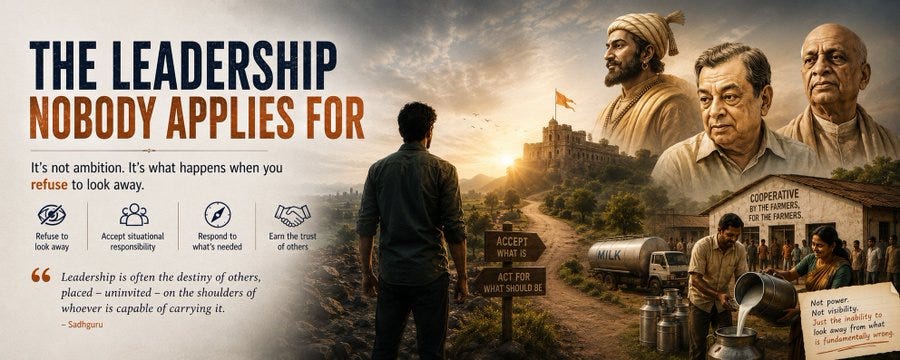
I first understood why that feeling can be something else entirely when I came across something Sadhguru said - that leadership isn’t ambition dressed up in a title. It’s a consequence. It’s what happens when someone with the capability to act simply cannot walk past a failure everyone else has learned to live with. He put it in a way I haven’t been able to shake since: leadership is often the destiny of others, placed - uninvited - on the shoulders of whoever is capable of carrying it.
That reframed the whole idea for me.
Leadership isn’t something you chase. It’s something that finds you, at the exact moment you refuse to look away.
Years before millions of litres of milk began moving through rural Bharat every single day, there was one man watching dairy farmers accept a system everybody else had accepted to call it normal. Dr. Verghese Kurien could have looked at that supply chain, understood its inefficiencies, and built a very profitable company off the back of it. Instead, he saw something else - an injustice baked into the market itself, where the people doing the actual work had no bargaining power and no choice but to depend on middlemen who took without giving back. So he didn’t just build a business. He built a cooperative that put the farmer at the center, with dignity, ownership, and real economic strength. He refused to accept exploitation as simply “how business works.”
Some people want leadership for the visibility. Some want it for the authority, or to be a step ahead of everyone else. But the leadership that actually changes anything rarely starts with wanting power. It starts with not being able to look away - when a situation is being handled badly, when unfairness has become routine, when everyone around you has quietly adjusted themselves to something wrong, and you simply can’t do the same.
Think of this as situational responsibility. It’s not the pettiness of wanting a piece of the world for yourself, or the need to look important in front of others. It’s a shift in the question you’re asking - from what can I get out of this to what does this actually need from me. Ambition tries to occupy space. Responsibility tries to answer a need. Those are two very different engines, even when they look similar from the outside.
Bharat’s own history is full of this. Shivaji didn’t emerge because he wanted power for its own sake - he emerged because the structures around him had failed to protect people’s dignity and freedom, and where everyone else had made peace with that failure, he refused to accept helplessness as the final word.
Sardar Vallabhbhai Patel is another one I keep coming back to. At the moment of independence, while the country was still catching its breath, it was also staring down the very real danger of coming apart into hundreds of pieces. Integrating the princely states wasn’t a ceremonial job - it took clarity, firmness, patience, timing, and a level of national responsibility most people never can just summon. Sardar Patel did not just administer a process. He stood, quite literally, in the gap between what the country was and what it needed to become.
That’s the first movement of leadership, as far as I can tell. Not dominance. Not noise. Not the need to be seen. Just an inability to look away from something that is fundamentally wrong.
But this is also where it gets dangerous. The same exhaustion that pushes someone to stand up can just as easily curdle into anger, reaction, ego. This is exactly what is happening with the student’s protests at Jantar Mantar and Parliament. We’ve seen it happen before also. Someone starts out standing against something unjust, and slowly, without noticing, they become consumed by the very ugliness they set out to fix. We see it around us all the time, in workplaces, in academic spheres, in politics.
So the question worth asking, every time that fire comes up, is: am I actually responding to what’s needed here? Or am I just reinforcing who I want to believe I am? It’s a subtle difference. But it decides everything that comes after.
Standing up may be the first movement of leadership, but it isn’t enough on its own. Plenty of people raise their voice for a moment and then disappear. Very few are ever trusted with something as serious as other people’s futures. That trust only comes when people sense you’re not doing this for attention, or emotional release, or the satisfaction of being right, but because you’ve given yourself, fully, to what actually needs doing.
Which leaves me with a harder question, the one I am trying to find an answer to: why should anyone trust a person just because they stood up once?
That’s what I want to sit with next.