


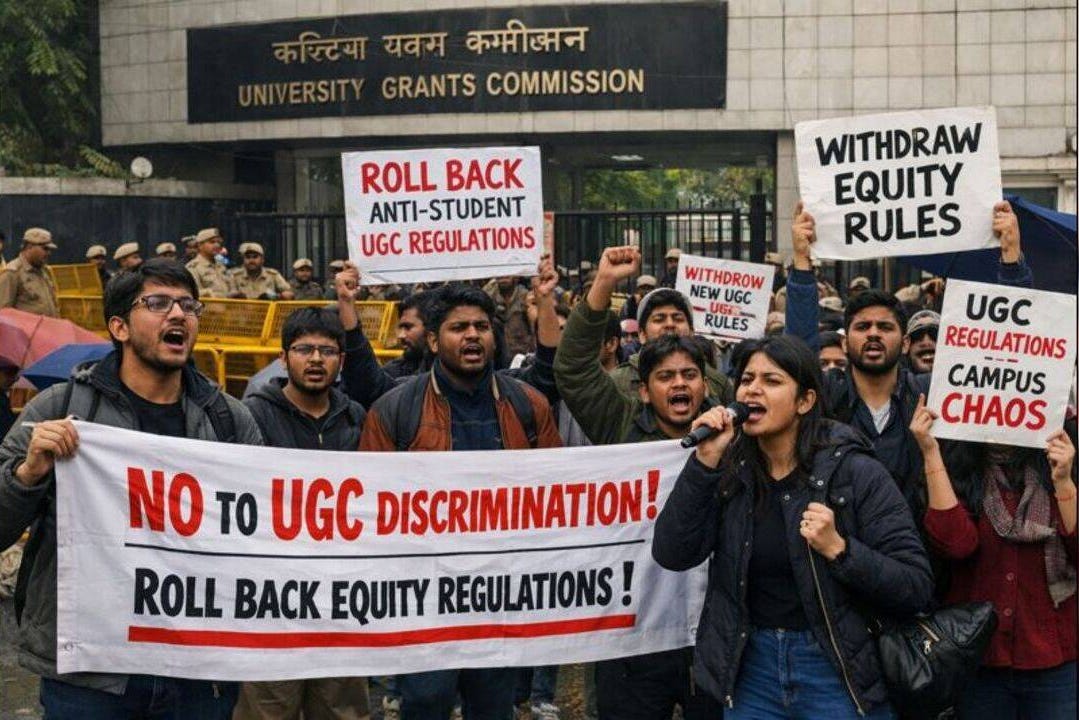
The UGC Equity Regulations 2026 originated from tragic student deaths (Rohith Vemula in 2016 and Payal Tadvi in 2019) and a related 2019 PIL filed in the Supreme Court. In a delayed response in the PIL, UGC proposed to amend the rules.
The UGS released a balanced draft in February 2025 included protections for SC/ST students while preserving institutional autonomy, due process for all, and penalties for false complaints to prevent misuse. The PIL petitioners were not happy and through their lawyer Indira Jaising, a known leftist anti-India player, they proposed further additions to the 2025 draft.
The final regulations, gazetted on January 13, 2026, seem to have largely adopted the Indira Jaising modifications. The result was that the regulations shifted dramatically: they narrowed caste-based discrimination protections asymmetrically to SC, ST, and OBC students only, introduced features like Equity Committees, Equity Squads/Ambassadors, anti-retaliation clauses, debarment powers, and mandatory proactive measures, but removed safeguards against malicious complaints.
A more detailed version of events can be read here.
New regulations opened a can of worms
The solution proposed by leftist lawyers for the victims was quite drastic. It opens the General category to malicious prosecution.
But that was not all. In something coming right out of 1984 or some leftist dystopian universe, the new rules have surveillance committees that have open mandates and unlimited power. The redressal mechanisms are also scuttled and tilted against the General category.
This is what happens when regulation aims for victim protections as against action against perpetrators.
How can it be made better?
The reality is that BOTH exists
some people (many from OBC category themselves) who commit caste based discrimination.
some OBC/SC/ST who abuse the protective laws.
No law, by itself, or in conjunction with an elaborate enforcement mechanism (no matter how elaborate) can prevent a certain person from FEELING victimized, as that feeling is flexible and comes from the persons own assumptions. (Refer the scar experiment on bias).
The problem is perpetrators are often serial perpetrators - i.e. those actually discriminating do it to many. These acts are often below the "legal threshold" for discrimination and hence they escape punishment. Western law has used the class-action as crutch to get around to this solution. Yet, it is still a crutch not a solution.
The solution is also not to loosen the definitions of discrimination or make up lop-sided enforcement mechanism. The more elaborate the law and the enforcement mechanism the more false positives it will throw up. And the more it will lend itself as a tool for misuse.
The real solution is to make these acts accretive.
If a few person levels allegation it could be fluke (CISCO case). But if many report the person for being discriminatory then it will reveal the pattern.
In India we need to create a anonymous reporting system that allows potential victims to report a person and discriminatory acts add up when more people report. The perpetrator is identified and investigated if the score based on impact of single act of discrimination and number of such acts crosses a certain threshold. This process should work in sexual harassment and gender bias cases too.
I believe, if a well thought out system is created based on above it will be a proper legal infrastructure innovation at global level.
Clarification with respect to “anonymous” reporting.
The reporting is not itself anonymous, the database is black boxed. It means I can submit complaints with my annexures. These complaints are analyzed by anonymizing the names of perp and vic. They are then entered into this black boxed database. They are scored based on gravity of allegation, validity of proofs submitted (CCTV etc. is stored) AND number of allegations.
Thus
If there are many allegations against one person his score increases and the entire lot (ALL allegations with their known complainants and their submissions) is opened and investigated.
Similarly if there is just one allegation but it is quite serious, it will still trigger an investigation.
Further, a grievous false allegation is also reported and such a false complainant can be tagged and reported.
During open investigation the identities of all will be available to investigating and judicial/quasi-judicial team.
This prevents minor misunderstandings from escalating into witch-hunts. At the same time it ensures those who are casually discriminatory but just below the threshold are still caught.
The conduct of investigation and penalties and punishments are not mentioned in the proposal. They are governed by current law.
Current law does not punish the false complainant.