


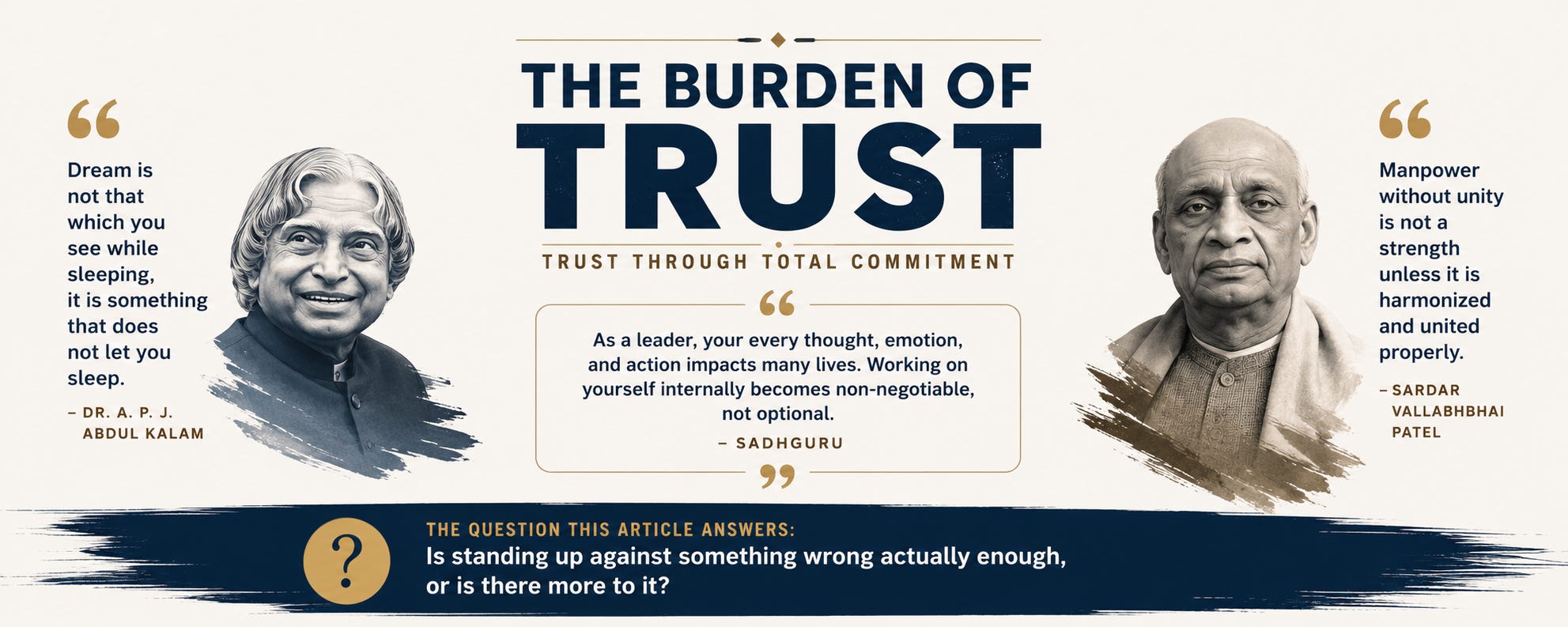
In Part 1, I was sitting with a question that felt urgent given everything happening around us right now: is standing up against something wrong actually enough, or is there more to it? I keep coming back to Kurien, Shivaji, Patel, people who didn’t just refuse to look away, they built something lasting out of that refusal.
But the moment someone stands up, a harder question follows them. Why should anyone trust them?
Because let’s be honest, a lot of people are disturbed by injustice. A lot of people can speak with conviction when something is wrong. A lot of people can gather a crowd around a grievance for an afternoon. None of that, on its own, makes someone a leader. I think leadership only starts to mature when people can sense that the person isn’t doing this for attention, or to feel something, or to protect their own image. They have to sense something underneath all of that. Total commitment.
I think about Dr. Kalam a lot in this context. He never led through aggression or authority, he wasn’t trying to dominate anyone’s imagination. People trusted him because they could feel his commitment was real, to learning, to the country, to science, to young people who could suddenly picture themselves doing something extraordinary. His influence never came from command. It came from inspiration, which is a completely different currency.
And that’s really the point, isn’t it. Trust can’t be bought with a good speech. It can’t be manufactured through visibility, through slogans, through being clever on social media. People can be impressed by a personality for a while, sure. But they only trust what they experience as consistent, over time, when no one is applauding.
When someone gives everything of themselves to a cause, they stop being a person asserting their own ego, and start becoming something people can actually place their aspirations onto. People don’t follow because they’re forced to. They follow because they can feel that this person’s every action is genuinely for them, not for themselves.
That’s the weight of it, honestly. Once people place their trust in you, your thoughts stop being just your thoughts. Your emotions stop being just yours. Your actions stop being just individual choices. Many other lives start moving in response to how clear, or how confused, you are inside.
Sadhguru puts it simply: as a leader, your every thought, emotion, and action impacts many lives, so working on yourself internally becomes non-negotiable, not optional.
This is why I don’t think leadership can ever be reduced to performance. You can speak well, strategize well, mobilize a room well, but if you haven’t done the work on yourself, your own unresolved stuff eventually leaks into whatever you’re trying to build.
When someone actually does that inner work, three things tend to show up naturally. Integrity, insight, inclusiveness.
Integrity, he says, and how I understand it, is simply no gap between what you know, what you intend, and how you act. What you say outwardly has to have roots inside you, otherwise it’s just theatre. Lal Bahadur Shastri is the example that comes to mind. His simplicity wasn’t a strategy for optics. It was just who he was, aligned all the way through. That’s why, in a time of real scarcity, people were willing to sacrifice alongside him, because they could feel he wasn’t asking them to do something he wasn’t already doing himself.
Insight is the ability to see what’s actually shaping a situation, not just the surface of it. Most people see events. Very few people see the pattern underneath the events. Which is what we really need to see with these protests that are happening in the country right now.
Inclusiveness is realizing leadership was never about making yourself bigger. There’s really only one business any of us are in, human wellbeing. And a leader who doesn’t include people in how they think, eventually starts using people, even while claiming to speak for them.
The moment people sense that someone’s commitment is selective or self-serving or performative, something breaks. People might keep going along with it for sometime, but they stop giving themselves fully. And I think that’s the difference between being followed and being trusted.
We live in a moment where commitment gets confused with visibility constantly. The loudest voice gets assumed to be the strongest. The most visible person gets assumed to be the leader. The most followed account gets assumed to be the most capable. But none of that has ever actually been true. Leadership has never belonged to the loudest person in the room. It belongs to whoever’s commitment is still there after the applause has stopped.
Which brings me to the question I want to sit with in Part 3: is leadership the ability to be seen, or the willingness to stay committed even when nobody’s watching?