


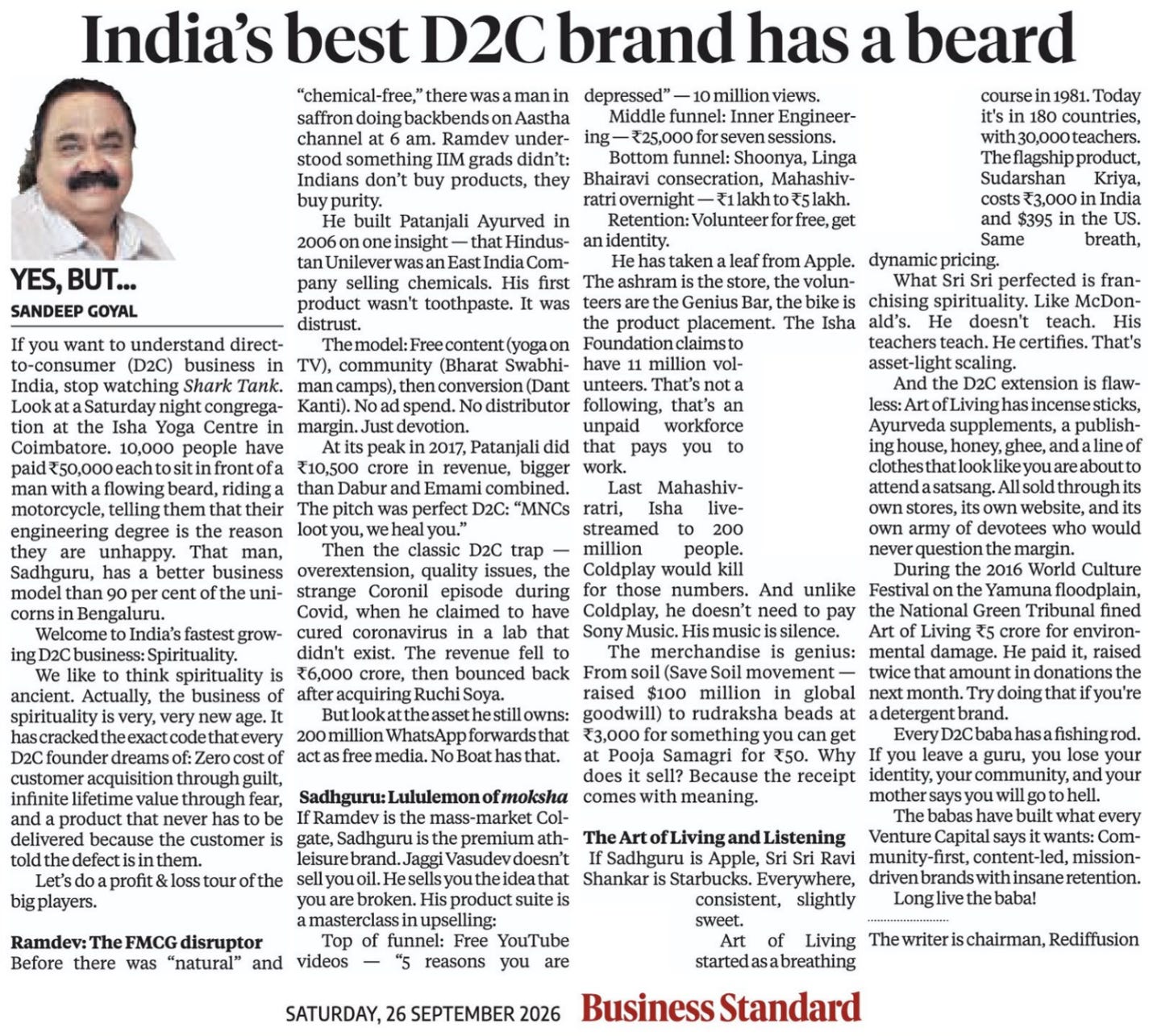
NO, BUT...
If you want to understand the Guru, stop reading business papers. Sit at your grandmother’s pooja on Guru Purnima and watch her bow. She isn’t a customer and nobody has sold her anything. She is bowing to something that was here long before IIM, Shark Tank or D2C.
Welcome to India’s oldest institution: the Guru parampara.
We like to think anything that grows fast must be a business. That’s a very new-age idea. The parampara is older than money. It started with Adiyogi, the first Guru, who sat by Kanti Sarovar and gave the science of yoga to seven disciples, the Saptarishis. There was no fee, no funnel and no WhatsApp forward. For thousands of years, that transmission has passed from Guru to disciple, from Kashi to Kedar and from Shankara to Ramana.
To call it a D2C business is to call the Ganga a water-supply company.
Let’s do an honest tour of what the column missed.
The Guru: not a founder, a dispeller
“Gu” means darkness and “ru” means one who dispels it. A Guru isn’t selling light. He is removing what blocks it. Sadhguru has said again and again that a Guru isn’t there to give you teachings or beliefs. He is there to throw you into seeking.
The column says the customer is told the defect is in them. Sadhguru says the opposite. He says every human being is the source of their own joy and misery. That isn’t a defect, it’s freedom. If the problem is inside you, the solution is also inside you, and no MNC or baba can sell it to you.
That’s not a business model. It’s the end of one.
Sadhguru on business: money in the pocket
Now let’s talk business, since the column loves it.
Sadhguru has never said money is evil. He says, “Money should be in your pocket, not in your head.” He talks to CEOs at Davos, farmers in Tamil Nadu and students at IIT. He says business is simply a way of fulfilling human needs, and when business forgets human wellbeing, it becomes destructive.
He says the economic engine is powerful. Without inclusive consciousness, it will eat the planet. That’s why he speaks about soil, rivers and farmers, because business should serve life, not the other way around.
Isha helps farmers form producer organisations so they get fair prices for their crops. That’s business done his way: the farmer earns and the middleman doesn’t.
Compare that with the column’s idea of business, where everything becomes a funnel and every devotee is a data point.
The funnel that isn’t one
The top of the “funnel” is free. Isha Kriya, a guided meditation, is free, and so is Upa Yoga. The Miracle of the Mind app is free. Mahashivratri is free to attend and free to stream. Anyone can sit at Adiyogi without paying a rupee.
A funnel where everything is free at the top and the bottom is not a funnel. It’s a well. Anyone can draw water.
The bike is not a billboard
The column calls the motorcycle product placement. In 2022, at 64, Sadhguru rode it for about 30,000 km across 27 countries, alone, for 100 days, to ask governments to save soil. If that’s product placement, the product is the planet, and it’s not for sale.
Volunteers: not unpaid labour, but seva
The column calls volunteers “an unpaid workforce that pays you to work.” Every Sanatani knows this word. It’s called seva, and it existed long before HR departments.
At the langar in the gurudwara and the annadanam in our temples, nobody is paid and nobody is exploited. Seva isn’t work. It’s an offering.
Sadhguru says a volunteer is simply someone who is willing, and willingness can’t be bought. Try hiring it.
Rudraksha: a bead is not just a bead
The column says a rudraksha costs ₹50 at Pooja Samagri. Maybe. A shivling is also just a stone and a temple is also just bricks.
In our tradition, prana pratishtha, consecration, changes a stone into a living force. That’s why Hindus have built temples for thousands of years. We didn’t build them for Instagram. We built them for energy.
Isha has also offered consecrated rudraksha free to people ahead of Mahashivratri. The column forgot to mention that.
“If you leave a guru, you lose your identity”
This is the most ignorant line in the article. The whole purpose of the Guru is to destroy your identity: your ego, your labels and your limited self. Sadhguru calls it dissolving the boundaries. A Guru doesn’t give you an identity. He takes it away.
No Sanatani mother tells her child they’ll go to hell for leaving a Guru. There’s no hell in that sense in our tradition. The column has mixed up someone else’s theology with ours.
The part the P&L can’t see
There are schools for rural children, medical care in villages, trees planted on farmers’ own land and rivers being revived. None of this is revenue. All of it is service.
The Guru parampara has survived invasions, colonisers and missionaries, and it will survive columnists too.
Every institution has critics. Criticise the fees if you want, and question the accounts. That’s fair. But when you call the Guru a salesman and seekers customers, you aren’t doing business analysis. You’re mocking a civilisation.
The column is right about one thing: the Guru has insane retention. But not because of fear or guilt. When someone shows you the way inward, you don’t need to be retained. You stay.
Try doing that if you’re an ad agency.
Guru Brahma, Guru Vishnu, Guru Devo Maheshwara!