


Yesterday, I would have said the child belongs with the mother. As a mother myself, I would have fought for that right.
Today, I am not so sure.
Not after readin
S. L. Bhyrappa’s Vanshavruksha, and especially this conversation.
It has got me thinking.
I don’t know what I would have done in Katyayani’s place. I hope I never have to be in such a situation. But the question she faces is worth thinking about.
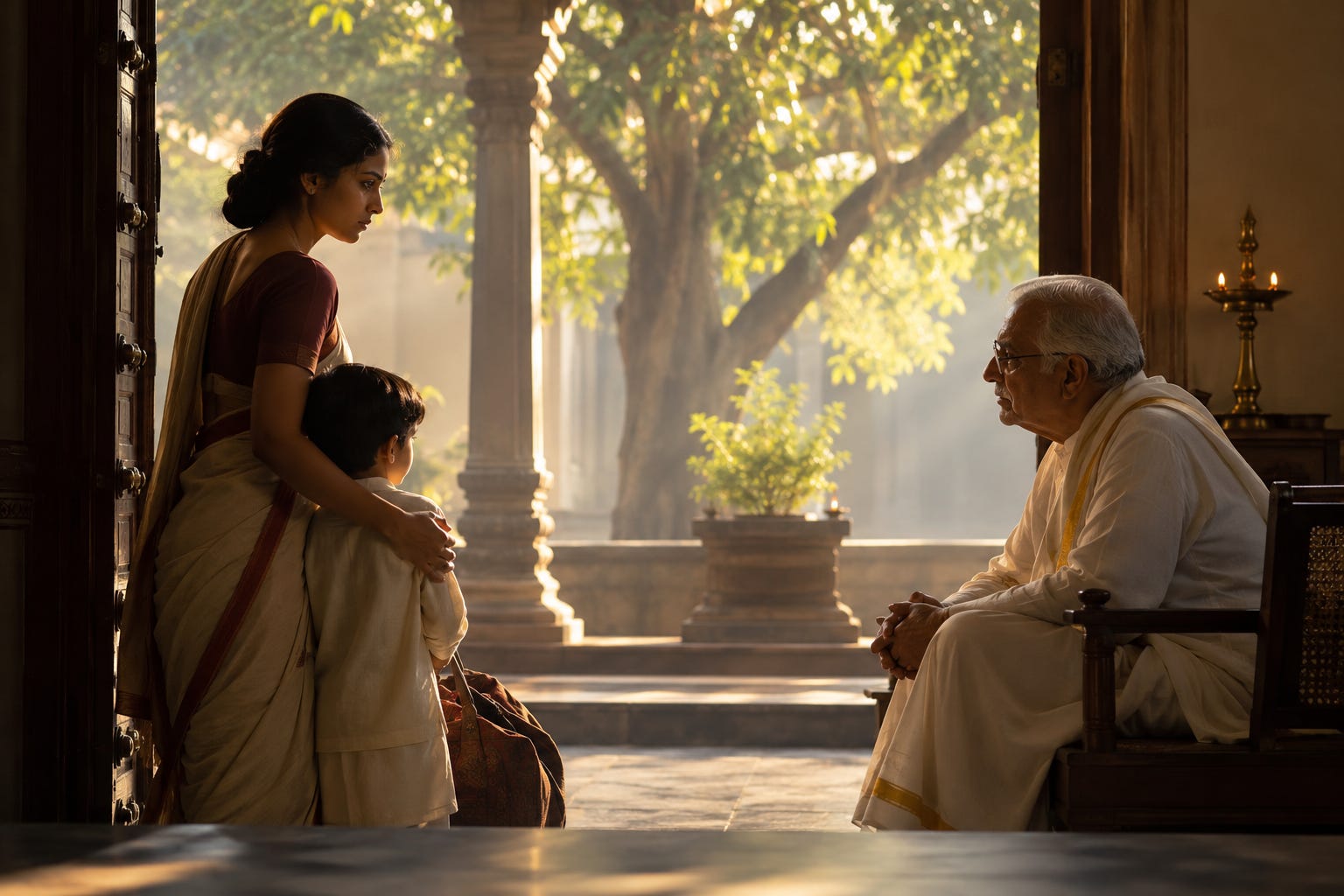
A little background: Katyayani’s husband has passed away, and she has remarried. She wants to take her son, Chini, with her, and her new husband is completely supportive. Her former father-in-law, Anna, is a kind and thoughtful man. He explains why he believes the child should remain with his father’s family. But he does not force her to stay or threaten to fight her in court. In the end, he leaves the decision to her conscience.
We just had Mahalaya.
For many of us, Mahalaya is a time to remember our ancestors, express gratitude for what we have received from them, and acknowledge that we are part of a lineage that began long before us and will, hopefully, continue long after us.
We perform rituals for those who came before us. We speak of Pitru Rina, our debt to our ancestors. We recognise that we have inherited more than a body: a name, a family, traditions, values, and a place in a continuing chain of generations.
But it is one thing to celebrate these ideas through rituals and understand their meaning intellectually. It is quite another when life places an impossible Dharma Sankat before us.
What happens when a mother’s natural love for her child comes into conflict with the continuity of the family into which that child was born? What happens when her right to begin a new life collides with the family’s understanding of its responsibilities towards the next generation?
This is precisely what makes Katyayani’s dilemma so intriguing.
It is one thing to speak of Dharma. It is quite another to discern Dharma when every choice comes at a cost.
Here is the conversation from Vanshavruksha, translated into English.
Katyayani: I want to take my son with me.
Anna: Katyayani, even in England (the story is set in the British colonial era), a child belongs to the family into which he was born. Even if a widow remarries, her children continue to carry their father’s name.
Katyayani: To live away from one’s own child is terribly difficult for a mother. You know that too, Anna. What more can I say?
Anna: This is not merely a question of the mind or the heart. We must look at it from a different level.
I have nothing to say against the love between a mother and her child. I have no doubt about that love.
But do you think we have no affection for him in our hearts?
Your husband died. You found another husband. Can we find another son in place of the one we lost?
That boy was our son. How can his son now belong only to you?
I do not believe that a child belongs exclusively to the mother. Nor do I believe that a child belongs exclusively to the father.
Children belong to the lineage. If any one person tries to claim exclusive rights over them, it will benefit no one.
As long as you were part of this family, you had a place in it. You had a claim to everything within this family, and that included Chini, your son.
But once you step outside that circle, how can you claim ownership over what lies at its centre?
Katyayani: I am not talking about rights, claims or ownership, Anna. I am talking about a mother’s claim that comes from within her very being.
Anna: Without the foundation of lineage, can motherhood be celebrated with pride? Motherhood, fatherhood and brotherhood — all these relationships acquire their particular meaning within the framework of vansha, of lineage and family.
A man and a woman become husband and wife, in the first place, for the continuation of the lineage. How, then, can motherhood be separated from all of this?
Katyayani: There is a fundamental difference between your outlook on life and mine.
You believe that the individual exists for the lineage. From my perspective, the life of the individual is more important.
Anna: When our basic outlooks differ so fundamentally, what can further discussion achieve?
You will at least agree that grandparents have as much of a claim over a child as the parents do?
But leave that aside. If you take Chini away today, will you be able to raise him in such a way that he proudly identifies himself with the Shrotri family?
Will he perform the rituals for his father and ancestors as he does today? Think about how strange that might become in your new household.
Katyayani: I do not believe in these rituals.
Anna: This is not merely a question of whether you believe in them or not.
When Chini grows up, he will legally inherit the property of the Shrotri family, even if he lives with you. If he has no emotional attachment to that family’s traditions, beliefs and religious customs, will he still have the right to accept its wealth?
And this is not just about property.
Look at it from another perspective. We inherit our bodies from our parents. Along with those bodies, we also inherit certain innate qualities and dispositions.
To say that we want the body but none of those other things — is that not a contradiction?
A seed from one lineage is placed in the field of another lineage so that the former may continue. In nurturing that seed within her womb, the woman, too, finds a sense of fulfilment in her life.
But once a woman has become a mother, she remains a mother forever. How can she return to being a maiden and accept the role of a new wife as though motherhood had never happened?
Once a gift (daan) has been given, how can it be given again?
When life has reached a particular stage, to turn back from the perspective of experience is contrary to the laws of nature.
I am not saying all this to hurt you, my child.
Katyayani: Then… can I take Chini with me?
Anna: Under the law, you may perhaps be able to take him.
But the law cannot give you Dharma.
Even if you take him away, I will not go to court to protect the reputation of the Shrotri family.
You are free to make your own decision. But I do not have the right to lift him up and place him in your hands.
Katyayani: Why do you say that, Anna?
Anna: One branch of a lineage tree does not have the authority to cut off another branch and give it away.
I will never tell you to leave him here for my sake or for the sake of an old woman — my wife, his grandmother — who is sitting here crying.
I have never expected him to be my support in old age.
Go into that room. Chini is sleeping there.
Think once again about what I have said. If, even after that, your conscience permits you to take him away, then take him without hesitation.
I will make sure that neither your father nor Bhagirathi, my wife, interferes or opposes you.
— End of the conversation.
What stayed with me was not simply Anna’s argument. It was the question he left Katyayani with.
He did not force her to stay. Nor did he simply hand over the child. He asked her to think.
And that is precisely what this conversation has made me do.
The framework of Dharma begins with a different question.
Instead of beginning with the individual and asking what the individual is entitled to claim, it begins with the larger web of relationships, responsibilities and continuity within which the individual exists.
The Western, individual-centred framework often starts with the rights, choices and autonomy of the individual, and then asks how society should accommodate them.
The Dharmic framework asks us to consider the individual in relation to the family, the community, the ancestors and the generations yet to come. It asks us to look beyond an isolated claim and examine the responsibilities and consequences that arise from our place within this larger whole.
This is not to say that one framework has all the answers and the other has none. Nor does invoking Dharma automatically resolve a dilemma.
Because here, the individual is not just a mother. The child is not just a child. There is a father who is no longer alive, grandparents who have lost their son, a mother who has remarried, a new family, and a child who has a life of his own ahead of him.
Every relationship has a claim. Every choice has consequences.
So, whose claim takes precedence?
The mother who carried and gave birth to the child?
The father’s lineage, into which the child was born?
The grandparents who see him as the continuation of their family?
Or the child himself, whose future must not become a battleground for competing claims?
And what about the Dharmic framework itself, in which a family is not merely a collection of individuals, but a lineage with its own continuity, responsibilities and place in the larger order of life?
Can the question be answered by asking who has the right to the child? Or must we first ask what is right for the child, the mother and the family as a whole?
I don’t have an answer.
Yesterday, I had a clear answer to the question: Who does the child belong to?
Today, I am not so sure.
And perhaps that is the point of reading a book like Vanshavruksha, not necessarily to find answers, but to question assumptions we have held without ever examining them.