


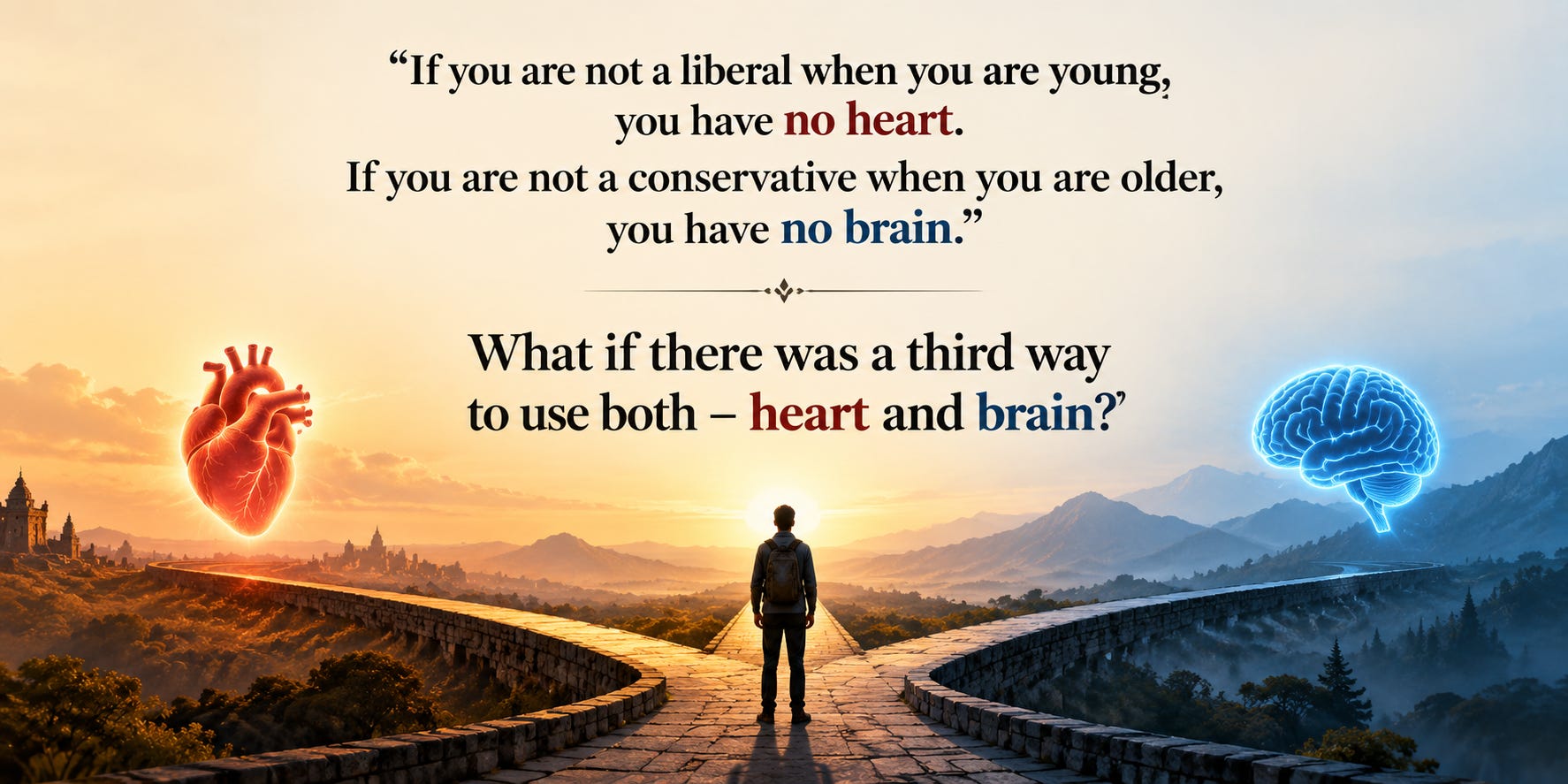
“If you are not a liberal when you are young, you have no heart. If you are not a conservative when you are older, you have no brain.”
This saying captures a dilemma many experience as they grow older. Youth makes us sensitive to injustice. Experience teaches us that good intentions do not always produce good outcomes. Institutions are complicated, and dismantling something is easier than building a better alternative.
I experienced this tension during the Anna Hazare movement of 2011. Like thousands of Indians, I was moved by the demand for accountability and a cleaner political system. Yet it left me wondering: What happens when a movement that begins with a legitimate grievance enters politics? Can its moral force survive the responsibilities and compromises of power?
I realised that the liberal-conservative divide does not fully answer these questions. I must therefore think from a third perspective: the Dharmic perspective, which allows me to retain both my heart and my brain.
Beyond the Heart and the Brain
The liberal instinct questions authority and challenges injustice. The conservative instinct recognises that institutions and traditions carry accumulated experience.
Both matter. A society that never questions its institutions risks preserving injustice. One that constantly dismantles them may destroy structures essential to collective life.
Bharatiya thought offers another framework: Dharma.
Dharma encompasses duty, righteousness, responsibility and moral order. It asks us to consider our circumstances, the consequences of our actions and what sustains society. It neither demands blind obedience nor requires us to preserve everything inherited from the past.
The Mahabharata explores conflicts between competing duties, while the Bhagavad Gita challenges Arjuna to understand his responsibilities and act with discernment.
Applied to politics, Dharma asks whether we understand the problem, our responsibilities and the consequences of our proposed solutions.
Dharma asks the heart to care and the intellect to discern. It disciplines both through RESPONSIBILITY.
When a Movement Becomes the Destination
The Anna Hazare movement brought widespread frustration with corruption into national debate. I shared that frustration. But identifying a problem does not automatically mean knowing how to solve it.
Protest and governance require different skills. Governance involves legislation, administration, institutional design and accountability for outcomes.
Arvind Kejriwal and other former activists founded the Aam Aadmi Party in 2012, taking their challenge to the political establishment through electoral politics. This was a legitimate democratic choice, but it raised an important question: could the movement’s promise translate into lasting institutional reform? Would its leaders apply the same standards of accountability to themselves that they had demanded from others?
These questions apply to every political party. A movement’s original cause does not exempt it from scrutiny, just as disappointment with its performance does not invalidate its original grievance.
A good cause does not guarantee good governance. Moral outrage is a beginning, not a governing philosophy.
Dharma asks us to preserve the legitimacy of a grievance while examining the quality of its proposed solution.
Dismantling: The Difference Between Disruption and Reform
Institutions consist of people, procedures, legal responsibilities and relationships with other institutions. Before abolishing a department, we must understand what it does, who depends on it and how its essential functions will continue.
This is not an argument for preserving every institution. Some protect vested interests or perpetuate injustice and may require substantial reform. But change must begin with diagnosis. Dismantling a structure without understanding its interdependencies can create a vacuum that something worse may fill.
Elon Musk’s involvement with the US Department of Government Efficiency (DOGE) illustrates the risks of rapid disruption. Its ambitious cost-cutting approach reflected a familiar Silicon Valley instinct: identify inefficiency and eliminate it quickly. But government operates within constitutional limits, legal obligations and responsibilities towards citizens. Processes that appear inefficient may protect due process or ensure continuity.
In my Organiser article, “Why Musk’s 130-Day Crash Reinforces the Need for Bharat’s Ancient Wisdom”, I explored why sustainable reform requires more than disruption.
India offers useful examples of a different approach. Implementing GST required constitutional changes, coordination between the Centre and states, technological infrastructure and continuing adjustments. Direct Benefit Transfers sought to reduce welfare leakages through better beneficiary identification and direct transfers to bank accounts. Both illustrate the importance of building systems and improving their functioning rather than simply announcing cuts.
The farm laws offer another lesson. Following sustained farmer protests, the government withdrew them. Whatever one’s view of the laws, the episode demonstrates the importance of public acceptance and course correction.
Indian reforms also face challenges, and not every initiative succeeds. The broader lesson is that announcing disruption and delivering durable reform are different tasks.
The Arthashastra examines administration, resources and public welfare. The Bhagavad Gita’s idea of Nishkama Karma encourages committed action without obsessive attachment to personal rewards. Together, they point towards leadership that combines purpose with discipline.
Gradual transformation is not an excuse to delay necessary change. It makes change more sustainable through research, consultation, planning and correction. Urgent problems may require swift action; complex systems may need phased reform.
The Dharmic question is simple: Have we improved the system, or merely changed its appearance?
The Third Pillar: Our Way Forward
Political debates often pit progress against order, with each side claiming the moral or practical high ground. One may dismiss inherited wisdom without understanding it; the other may defend inherited arrangements without asking whether they still serve their purpose.
Dharma asks us to evaluate a reform on its merits, not merely by who proposes it. A policy is not wise simply because it is progressive or traditional. Its circumstances, consequences and contribution to collective welfare matter.
As we grow older, experience can make us discerning, but it can also make us cynical. Distrusting every promise of change is not wisdom. Neither is excusing a leader’s failures because we believe in the cause.
We must challenge authority without assuming all authority is illegitimate. We must respect institutions without allowing them to escape accountability. And when our preferred solutions fail, we must have the humility to reconsider them.
The Anna Hazare movement taught me to recognise the moral force of public anger against corruption. Its subsequent political developments reminded me that a legitimate grievance and successful governance are two different things.
We need the heart to recognise injustice, the brain to understand its causes, and Dharma to guide our actions.
Perhaps political maturity is not about choosing between the heart and the brain. It is about learning to use both under the discipline of Dharma.
The heart tells us something is wrong. The brain helps us understand why. Dharma asks what we ought to do, and whether our actions will truly serve the larger good.
We do not have to lose our heart to acquire a brain. We have to learn how to use both wisely.